

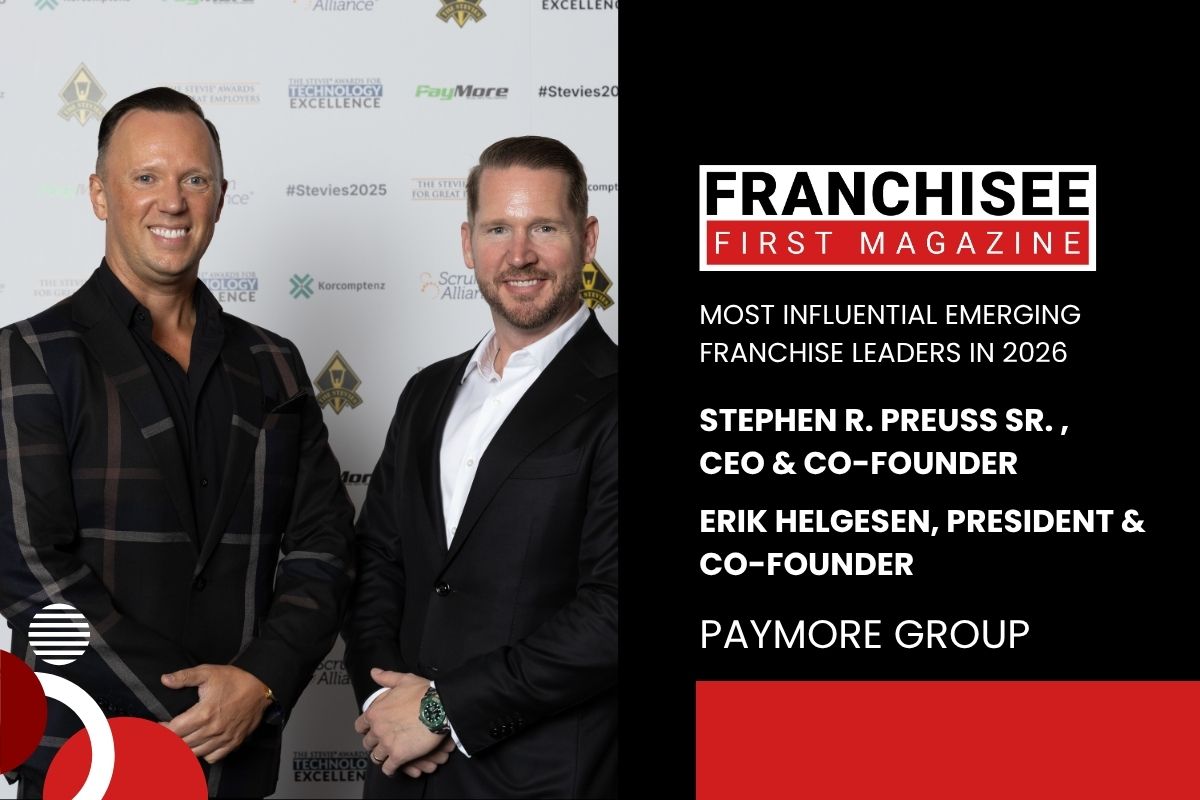
How Stephen R. Preuss Sr. and Erik Helgesen are combining complementary leadership strengths to build one of the fastest-growing electronics resale franchise network
The most interesting part of PayMore® Stores’ growth is not simply how quickly the company is adding locations. It is what is happening behind that growth.
More than 130 stores now operate across North America, the 150th location is set to open this fall, and hundreds more are in development. Over roughly two years, the network has nearly quadrupled in size. Yet for CEO and Co-Founder Stephen R. Preuss Sr. and President and Co-Founder Erik Helgesen, the bigger challenge is making sure the organization, technology, and franchise system grow with it.
That requires more than a strong business model. It requires leadership that can balance speed with discipline.
At the center of PayMore’s expansion is the partnership between Preuss and Helgesen. They share a common vision for the company while bringing different strengths to the table. That complementarity has become one of the defining characteristics of PayMore’s evolution, allowing the company to pursue innovation while maintaining the operational structure needed to support an expanding franchise network.
It is a partnership that has become increasingly important as PayMore moves beyond its early growth story and into a much larger phase of its journey.
A Different Way to Think About Electronics Resale
PayMore’s opportunity comes from a simple shift in how people think about technology.
An unwanted smartphone, laptop, gaming console, or computer component does not necessarily have to become waste. It can retain value, find another owner, or be refurbished and returned to use.
PayMore has built its business around that idea, but with the infrastructure required to make electronics resale feel more like modern retail than a fragmented second-hand market.
Proprietary technology and pricing intelligence, standardized operating systems, secure data destruction, certified recycling, and an elevated in-store experience all contribute to that model. The objective is to make buying, selling, trading, and recycling electronics more convenient and trustworthy while creating a business that can be replicated successfully through franchising.
That combination is increasingly resonating with both consumers and franchise operators.
Growth With a Purpose
The scale of PayMore’s current expansion tells only part of the story.
The company is not simply opening stores and counting locations. Existing stores continue to perform strongly while the network expands, suggesting that demand is growing alongside the franchise footprint.
Increasingly, PayMore is attracting experienced multi-unit franchise operators who have already built businesses across other brands. Investors and operators such as Paul Kushnir, Imbue Capital, and Chris Phillips represent the caliber of franchise partners choosing to participate in the opportunity.
Their interest points to several practical strengths within the model: operational simplicity, strong unit economics, lower staffing complexity than many retail or restaurant concepts, proprietary technology, established operating systems, corporate support, and the potential for long-term scalability.
For PayMore’s leadership, this creates an important relationship between corporate growth and franchisee success. The stronger the systems become, the better equipped operators are to build their local businesses. And as those businesses perform, the broader network becomes stronger.
That is the foundation on which PayMore is pursuing its next phase.
Staying Ahead of a Moving Market
Electronics is an industry where consumer behavior can change quickly.
A new smartphone launch can trigger a wave of trade-ins. Back-to-school season can increase demand for affordable technology. Major gaming releases can drive interest in consoles and related equipment. And the growing investment in AI infrastructure is contributing to increased demand for higher-performance computer components.
At the same time, consumers are becoming more comfortable with professionally tested pre-owned electronics. They are looking for ways to spend less without necessarily sacrificing quality, while sustainability is making the decision to extend a device’s useful life increasingly attractive.
PayMore sits at the intersection of these trends.
But the company is also finding opportunity in products that are not necessarily driven by the latest technology.
Classic gaming consoles, vintage games, and retro electronics have developed a strong following among collectors and enthusiasts. Some buyers are looking for technology they remember from years ago, while younger consumers are discovering it for the first time.
Because PayMore stores evaluate virtually any electronic device, these unexpected products can become part of the retail experience. A customer coming in to sell or recycle an old device may discover something completely different that they want to take home.
It gives individual stores a sense of discovery that traditional resale outlets may not offer.
Innovation Beyond the Storefront
For Preuss and Helgesen, keeping PayMore competitive means continuing to improve what happens behind the counter as well as in front of it.
The company continues to invest in proprietary technology, AI and automation, franchise operations, marketing infrastructure, local marketing support, customer experience, training, education, franchise development, and enterprise and B2B services.
That investment becomes increasingly important as the network grows.
A system that works for a small group of locations cannot simply be copied unchanged across a much larger franchise network. Processes need to become more efficient. Franchisees need better tools. Customers expect greater convenience. Corporate teams need stronger visibility across the organization.
PayMore’s approach is therefore built around continuous improvement rather than treating the franchise model as a finished product.
The same philosophy extends to marketing. Corporate and franchisee efforts are designed to work together, combining national public relations and brand-building with local media, seasonal campaigns, digital marketing, trade-in promotions, and initiatives tied to major technology and gaming launches.
The goal is not simply to make PayMore recognizable. It is to help individual franchise locations turn that recognition into local customer relationships.
Where Sustainability Becomes Part of the Business Model
Perhaps the clearest example of PayMore’s broader approach is its treatment of unwanted electronics.
Every device entering a PayMore store is first evaluated for reuse. Recycling comes afterward when an item is no longer suitable for another useful life.
That philosophy is reflected in the scale of PayMore’s current operations. The company is on pace to recycle approximately 2 million pounds of electronics annually and is currently purchasing more than 100,000 devices each month. Together, these efforts help keep a growing volume of electronics in circulation and out of the waste stream. The company is also expanding enterprise recycling and IT asset disposition services, including secure data destruction.
Its recycling program has another important effect: it brings people into PayMore stores who may not have initially considered themselves customers.
The proposition is straightforward. If PayMore cannot buy a device, it can recycle it.
Customers can bring virtually any device to a PayMore location for free recycling. Items are checked for resale or trade-in value, personal data is securely wiped, and end-of-life electronics are processed through certified partners.
For the consumer, it creates a convenient way to dispose of unwanted technology responsibly. For PayMore, it creates another opportunity to establish trust and introduce customers to the broader buying, selling, and trading ecosystem.
That is where sustainability becomes more than a corporate initiative. It becomes part of the customer experience and the economics of the business.
Building What Comes Next
PayMore’s next milestone is already approaching: its 150th store is scheduled to open this fall.
But the number matters less than what it represents.
The company is now operating at a scale where leadership, systems, technology, franchise support, and culture must work together more effectively than ever. Continued expansion across the United States and internationally will require the organization to keep evolving while preserving the fundamentals that made the model attractive in the first place.
That brings the story back to the partnership between Stephen R. Preuss Sr. and Erik Helgesen.
Their shared direction, combined with different strengths, has helped PayMore move from an emerging franchise concept toward a rapidly expanding retail network. The next stage will demand the same balance: ambition without losing discipline, innovation without losing consistency, and growth without losing sight of the franchisees and customers who ultimately determine whether that growth lasts.
PayMore is entering that stage with significant momentum.
Its opportunity is no longer simply to participate in electronics resale. It is to continue shaping what the category can become, giving consumers more ways to extract value from technology, giving entrepreneurs a scalable franchise platform, and giving electronics a longer life in the process.
The next chapter, for PayMore and its two founders, may ultimately be defined not by how many stores they open, build a system capable of supporting everything that comes next.