

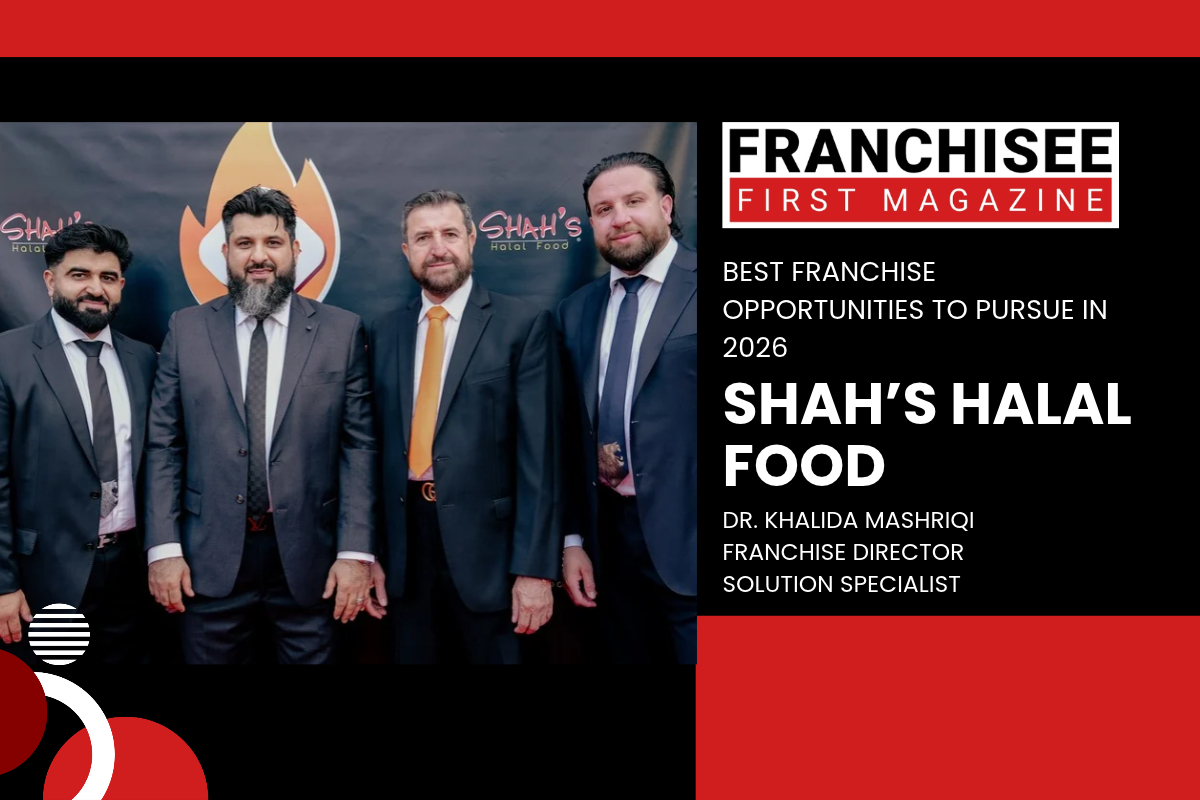
In 2005, Shah’s Halal Food began with something modest: a single food cart in Richmond Hill, Queens. There was no large restaurant network, sophisticated franchise system, or expansive infrastructure behind the business. There was simply a family, a shared ambition, and a commitment to serving quality Halal food at a good value.
Four family members, Khalid Mashriqi, Ibrahim Mashriqi, Shafiq Mashriqi, and Rahimullah Mashriqi, came together to build the business. Each brought a different strength to the table. Shafiq was the first to serve what would eventually become Shah’s signature dishes, while Ibrahim developed the chicken marinade and white sauce that helped establish the brand’s flavor identity.
At the time, the focus was straightforward: serve customers well, make good food, work hard, and give people a reason to return.
That simple philosophy became the foundation for what Shah’s Halal Food would eventually become.
Today, the company has grown far beyond its original cart and developed into a growing franchise organization. Yet, according to Rahimullah Mashriqi, Vice President and Chief Operating Officer of Shah’s Halal Franchising Inc., the principles behind the business have remained remarkably consistent.
“Quality food, consistency, hard work, value and respect for the customer” continue to shape the brand.
Growing Beyond the Original Cart
For Shah’s, growth did not happen overnight. One of the earliest lessons came from realizing that demand for the food extended beyond a single cart and neighborhood. As the business expanded its operations, the family began to see that the concept could be replicated successfully.
A major milestone arrived in 2016, when Rahimullah opened Shah’s first brick-and-mortar restaurant in Hicksville, New York. Moving into a permanent restaurant gave the company an opportunity to create a more complete customer experience while developing stronger operating standards.
It also revealed something important about scaling a food business. Opening additional locations was only one part of the challenge. The organization needed the infrastructure to support them.
Distribution, logistics, accounting, technology, training, construction, product development, compliance, and marketing all became increasingly important as Shah’s expanded.
That foundation eventually paved the way for another major chapter.
In 2024, Shah’s officially began franchising. After nearly two decades of building the business and refining its systems, the company was ready to give entrepreneurs an opportunity to become part of the brand’s next phase of growth.
That growth has accelerated quickly. Today, Shah’s Halal Food has 144 operating locations across the United States, with an additional 46 locations in development. The company has also established an international presence and continues its expansion into markets across Europe and North America. For Rahimullah, the pace of growth makes disciplined systems and the right franchise partners more important than ever.
For Shah’s, franchising was not simply about adding locations. It was about taking years of operational experience, recipes, supply chain capabilities, training systems, and brand standards and creating a framework that franchise partners could use to build their own businesses.
Dr. Khalida Mashriqi joined Shah’s Halal Food in 2023 as Franchise Director, bringing extensive experience in education, administration, and organizational leadership. She has played a significant role in developing and strengthening the franchising department, implementing structured processes for franchise development, franchisee onboarding, compliance, training, documentation, and accountability. Working closely with the founding leadership team, she has helped establish the systems and infrastructure necessary to support the company’s rapid national and international expansion.
Shafiq Mashriqi serves as Chief Procurement Officer, Treasurer, and Founder. His responsibilities include procurement, vendors, inventory availability, product quality, pricing, logistics, and involvement in site selection. Shafiq was also the first to serve Shah’s signature dishes from the original Richmond Hill cart, and the Shah’s name comes from his childhood nickname.
Rahimullah Mashriqi, Vice President and Chief Operating Officer, oversees business operations, technology, accounting, and training. In addition to being one of the original partners, he opened the first brick-and-mortar Shah’s restaurant in Hicksville in 2016, helping move the brand from its cart roots into a permanent restaurant model.
As Shah’s has grown, the family’s different areas of responsibility have become part of the company’s operating structure. Khalid Mashriqi, Chief Executive Officer, provides overall leadership and direction for the organization. Ibrahim Mashriqi, President, remains closely involved in product development and the restaurant development process, including prototypes, layouts, operational flow, and construction. His role in the food dates back to the beginning: the original chicken marinade and white sauce were his recipes.
Leadership Built Around Complementary Strengths
A Brand Built Around Consistency
The restaurant industry offers customers plenty of choices. For Shah’s, earning repeat business starts with something fundamental: delivering an experience people can rely on.
Flavor, portions, value, convenience, and service all play a role. But consistency is what connects them.
Shah’s serves customers who specifically seek Halal food, as well as people who simply enjoy the food. That broader appeal has always been important to the brand. Rather than positioning Halal cuisine as something restricted to a particular culture or community, Shah’s has built its concept around making the food approachable to everyone.
Customers can customize their meals through different proteins, toppings, sauces, and menu formats. Whether someone has grown up eating Halal food or is trying it for the first time, the experience is designed to be familiar, accessible, and welcoming.
For Shah’s, this has helped turn individual customers into a diverse community of loyal patrons.
Protecting the Flavor as the Brand Expands
Scaling a restaurant concept presents a difficult question: how do you grow without losing what made the original business special?
For Shah’s, the answer has been systems.
The recipes, marinades, signature sauces, preparation methods, and products that define the brand have been developed and refined over many years. As the company grew, leadership recognized that these elements needed to be protected through a structured operating model.
Approved suppliers and distribution systems help maintain product standards. Standardized preparation procedures reduce unnecessary variation. Operational requirements help ensure that individual locations do not create their own interpretation of the Shah’s experience.
But consistency goes beyond the food.
A customer experiences the entire brand, from the moment they enter a restaurant to the quality of the food, cleanliness, service, speed, portioning, packaging, restaurant appearance, and overall value.
Shah’s has therefore focused on building systems around each of these areas.
As Rahimullah explains, consistency does not happen automatically. It has to be documented, taught, measured, and maintained.
“When we were smaller, we could personally see almost everything happening in the business,” Rahimullah says. “As we grow, our systems have to carry those same expectations into every location. That is how we protect what we built.”
That philosophy has become increasingly important as the organization grows.
Franchising as a Partnership
For Shah’s, franchising represents more than a business expansion strategy. It is a partnership between the company and entrepreneurs who understand their local markets.
A franchise partner brings leadership, energy, and knowledge of the community. Shah’s brings an established brand, products, operating standards, training, technology, development guidance, and an established framework.
The relationship works when both sides understand their responsibilities.
That is why the company places considerable emphasis on selecting the right franchise partners. Financial resources are important, but Shah’s believes that money alone does not make a successful restaurant operator.
The company looks for people with work ethic, accountability, leadership, sound judgment, and a willingness to follow the established system.
Most importantly, Shah’s values owner-operators and managing partners who are actively involved in their restaurants.
A franchise location cannot simply be treated as a passive investment. The owner needs to understand employees, know customers, monitor food quality, control costs, and protect service and cleanliness standards.
For Shah’s, the franchisee is not simply purchasing a business model. They are becoming responsible for representing the brand in their local community.
Building the Right Foundation for Franchisees
Supporting franchisees begins well before a restaurant opens its doors.
The process starts with site review and approval. Once a location moves forward, Shah’s provides guidance covering architectural plans, layouts, design, signage, equipment, technology, construction milestones, and required documentation.
Training is another major part of the process.
Shah’s Halal Food requires a minimum of two managers from each franchise location to complete its structured training program, which includes at least two weeks of training. Before opening, each restaurant undergoes a pre-opening inspection, followed by a required soft-opening period of at least one month to ensure operational readiness, employee preparedness, and adherence to corporate standards.
The objective is to make the transition into operations as structured as possible.
Behind the scenes, the company has continued developing systems for ordering, distribution, technology, training, documentation, and operational requirements. Manuals cover areas such as inventory, receiving, food preparation, food safety, cash handling, cleaning, equipment, opening and closing procedures, and management responsibilities.
For franchisees and their teams, the goal is simple: reduce uncertainty and create clear expectations.
Technology Without Losing Hospitality
Consumer expectations have changed significantly. Customers now expect restaurants to provide multiple ways to order, including in-person dining, online ordering, delivery, and catering.
Shah’s has invested in technology that connects restaurant operations with digital ordering channels and major delivery platforms.
At the same time, the company does not view technology as a replacement for hospitality.
Digital tools can make ordering faster and more convenient, but they cannot replace the fundamentals that bring customers back.
Food quality, accuracy, speed, cleanliness, and service still matter.
Personalization has also been part of the Shah’s experience from the beginning. Customers can choose their proteins, toppings, sauces, and meal formats, allowing them to create meals according to their preferences.
As consumer expectations continue to evolve, the company plans to keep evaluating new technologies and customer-facing initiatives while protecting the core restaurant experience.
More Than a Restaurant Format
Food carts are an important part of Shah’s history. They represent where the family started and helped establish the operating habits that would later become valuable across the organization.
Carts taught the business how to work efficiently, serve customers quickly, and build a following from the ground up.
Today, however, the company’s primary franchise development focus is brick-and-mortar restaurants. Permanent locations provide the strongest environment for consistent branding, training, operations, and customer service.
Catering adds another dimension by allowing restaurants to serve offices, schools, organizations, families, and community events beyond regular restaurant transactions.
Rather than expanding through every possible format, Shah’s is focused on disciplined restaurant development and sustainable growth.
The Opportunity Ahead for Halal Food
The growing mainstream awareness of Halal cuisine presents a significant opportunity.
For Shah’s, the potential extends beyond customers who specifically seek Halal options. More consumers are discovering Halal restaurants simply because they enjoy the food.
That creates opportunities in established markets as well as communities where the category is still developing.
International expansion is an important part of Shah’s Halal Food’s long-term growth strategy. Beyond its established presence in the United States, the brand has expanded into international markets, including the United Kingdom, Sweden, Canada, Germany, Switzerland, Norway, Italy, and Denmark. As the company continues to grow, its leadership remains focused on maintaining consistent food quality, strong operational systems, reliable supply chains, and brand standards across international locations.
However, Shah’s does not view international growth as a race to enter as many markets as possible.
Supply chain capabilities, regulations, real estate, training, quality control, franchise structures, and cultural considerations all need to align before entering a new market.
For the company, the priority is responsible expansion that can be supported for the long term.
Scaling the Business Without Losing Its Identity
One of the biggest lessons Shah’s has learned is that the systems required to operate a small business are not necessarily enough to operate a much larger organization.
When a company has only a few locations, leadership can personally oversee many aspects of the business. As the number of restaurants increases, that approach becomes impossible.
Technology, documentation, training, communication, supply chain controls, accountability, and compliance become essential.
The organization has therefore focused on strengthening its infrastructure alongside its growth.
Leadership has also placed greater importance on franchise partner selection. A new location is not automatically a successful location. The person operating it needs to be committed to the business, the customers, and the standards of the brand.
That mindset has shaped Shah’s approach to sustainable expansion.
For Rahimullah, increasing the number of locations is not the only measure of success. Building a strong organization capable of supporting franchisees and maintaining the brand’s standards is equally important.
“For me, growth is not just a number on a map,” Rahimullah says. “If we grow faster than our ability to support our franchisees and protect the customer experience, then we are not growing the right way.”
The Next Chapter
Looking ahead, Shah’s aims to become a nationally and internationally recognized Halal fast-casual brand while protecting the qualities that made the company successful in the first place.
Thoughtful expansion, stronger operational systems, investment in technology and training, improved supply chain capabilities, and consistency across the franchise network will remain central to that vision.
Franchise entrepreneurs will play an important role.
The company is looking for partners who want to build businesses rather than simply purchase franchises. Engagement, accountability, community involvement, and day-to-day leadership are qualities Shah’s believes will define its strongest franchise partners.
There is also a deeper story behind this next chapter.
Khalid, Ibrahim, Shafiq, and Rahimullah began with a food cart in Queens. What started as a family business has developed into a structured organization with a growing franchise network and a broader leadership team.
The company’s continued expansion has also been supported by the development of a more structured franchising department under Dr. Khalida Mashriqi’s leadership. Her focus on franchise development, standardized processes, compliance, training, and franchisee support has helped strengthen the foundation for sustainable growth. Together with the founding partners, she continues to contribute to Shah’s vision of becoming a leading international Halal restaurant franchise.
Yet, despite that evolution, the company has no intention of abandoning the spirit that started it all.
Every restaurant carrying the Shah’s name represents the work that began with one family and one food cart in Queens.
The challenge now is to preserve that entrepreneurial spirit while building the professional systems needed for a much larger organization.
For Shah’s Halal Food, the future is therefore not simply about opening more restaurants. It is about creating a franchise network built on strong operators, reliable systems, great food, and shared accountability.
The company’s story began with a cart.
Its next chapter is being written through the entrepreneurs, teams, and communities that are helping carry the Shah’s name forward.