

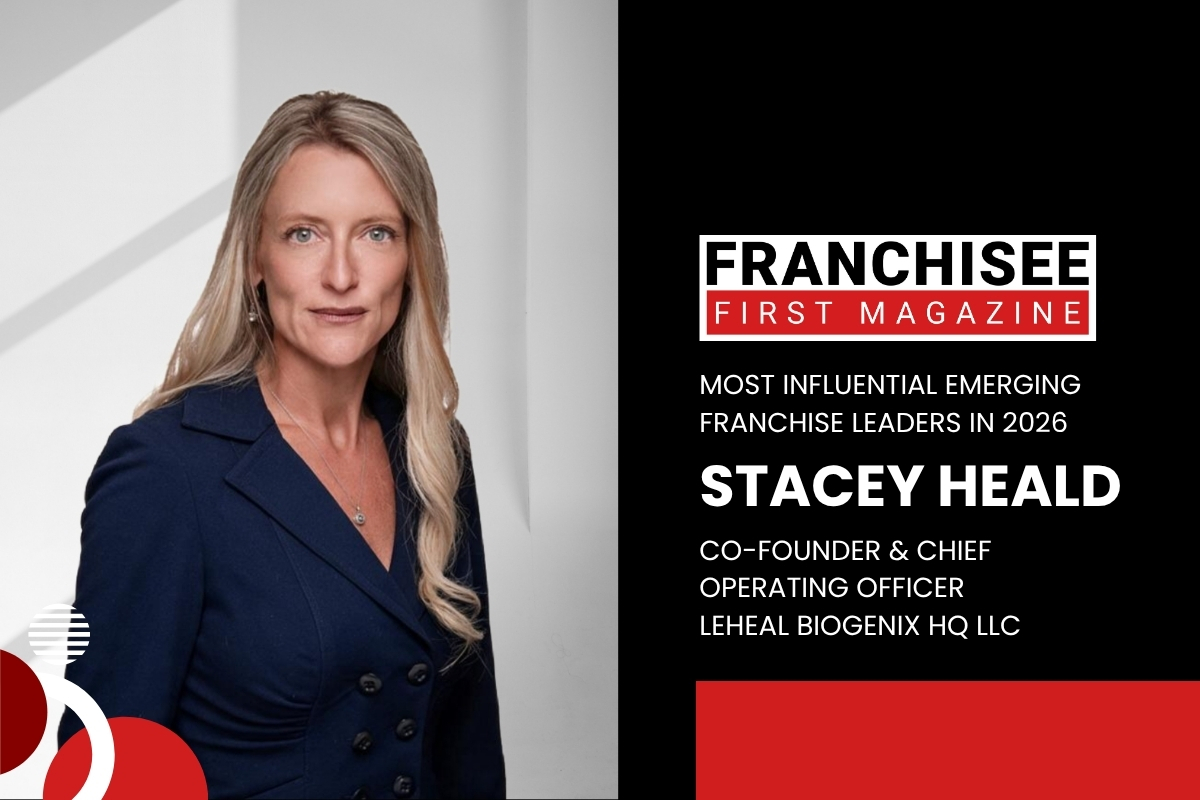
In an industry where expansion is often treated as the clearest measure of success, Stacey Heald takes a different view.
For her, the real question is not how quickly a company can open its next location. It is whether the business has earned the right to do so.
That distinction sits at the heart of Heald’s approach to franchising, healthcare, and entrepreneurship. With more than two decades spent navigating health and wellness, multi-unit operations, national expansion, franchise strategy, training, consulting, and executive leadership, she has seen firsthand what happens when a promising concept is pushed into the market before its foundation is ready.
Today, as Co-Founder and Chief Operating Officer of LeHeal Biogenix®, a physician-led regenerative medicine company, Heald is applying those lessons to a business she is building from the ground up. The company is preparing for an Orlando-area expansion targeted for the end of 2026, while evaluating strategic alliances, licensing opportunities, and the possibility of franchising in the future.
Yet franchising is not being treated as an automatic destination.
It is being treated as something that must be earned.
“Do not confuse enthusiasm for a concept with a true proof of concept. Build something that works. Understand why it works. Demonstrate that it can be replicated.”
That philosophy says much about Heald’s view of modern franchise leadership. Expansion matters, but preparation matters more. Systems matter, but people give those systems life. Standardization creates consistency, but it should never come at the expense of a personalized experience.
For Heald, sustainable scale begins long before the second location opens.
From Operator to Architect
Heald’s career has developed at the intersection of healthcare, wellness, and franchising. Her experience includes executive leadership with Medi-Weightloss Franchising USA, LLC, serving as Chief Operating Officer of Pvolve, and working with organizations as a fractional operations specialist and consultant. Across those roles, she has been involved in franchise strategy, operational performance, training, leadership development, financial improvement, and expansion.
The breadth of that experience has shaped an important realization: good ideas are plentiful, but organizations capable of consistently executing those ideas are far less common.
“Leadership is not about having every answer,” Heald explains. Instead, it requires asking better questions, listening carefully, providing clarity, and moving a conversation toward execution.
That perspective becomes increasingly important as organizations become larger.
Growth introduces complexity. Communication multiplies. Departments can become isolated. Priorities become blurred. Decisions can disappear inside an endless stream of emails, messages, meetings, and digital conversations.
Heald sees operational discipline as the mechanism that brings order to that complexity.
Defined ownership, streamlined workflows, effective communication channels, measurable expectations, and clear accountability allow teams to spend less time navigating internal noise and more time moving the business forward.
Her philosophy is ultimately people-centered. Employees perform better when they understand not only what is expected, but why their contribution matters. Strong leaders, in her view, do not attempt to control every decision. They develop people who can make sound decisions themselves.
That is the difference between managing an organization and developing an organization.
Building LeHeal Around a Real Need
The creation of LeHeal Biogenix® emerged from both professional experience and Heald’s interest in alternative approaches to healthcare.
As she explored regenerative medicine, she saw significant potential. She also saw a market that could be confusing for patients. Information varied. Pricing was inconsistent. Patients considering nonsurgical options could struggle to understand different therapies, determine what questions to ask, or develop realistic expectations.
The opportunity, as Heald saw it, was not simply to offer more treatments.
It was to create a clearer experience.
LeHeal Biogenix® was therefore built around physician-led care, transparency, accessibility, education, and individualized treatment. The intention was to help patients become informed participants in their healthcare decisions rather than feel pressured into a particular solution.
That patient-first philosophy is closely connected to Heald’s broader approach to business.
“I am a people person at heart. What drives me is creating a platform where patients can be educated, supported and empowered to better understand their bodies, the science behind their options and the choices available to improve their health and quality of life.”
The statement also reveals why her background in franchising matters to the company.
From its earliest stages, she was thinking beyond the walls of one clinic. How would the patient experience work? How would employees be trained? Which processes needed to be documented? What would have to exist before the model could responsibly enter another market?
Those questions changed the way the business was built.
The goal was not to create a location that depended entirely on its founders.
The goal was to create a business capable of functioning successfully beyond them.
Standardize the Experience, Not the Person
Healthcare presents a particular challenge for organizations seeking scale.
A franchise system thrives on consistency, yet medicine must remain personal.
Heald does not see those principles as contradictory.
Clinical decisions should remain in the hands of appropriately qualified medical professionals because every patient arrives with a different history, condition, and objective. What can be standardized is everything surrounding responsible clinical care.
That includes patient intake, education, documentation, informed consent, treatment preparation, scheduling, follow-up communication, training, sourcing, quality standards, and the workflows connecting each stage.
The objective is consistency without becoming impersonal.
“My philosophy is to standardize the experience without depersonalizing the care.”
It is a subtle distinction, but an important one.
The best operating systems, according to Heald, should not replace capable people. They should give those people the structure, information, and clarity necessary to perform well.
In a multi-location healthcare environment, that balance becomes even more critical. Strong infrastructure must coexist with clinical judgment and genuine human interaction.
For Heald, technology and processes are tools. They are valuable precisely because they allow people to focus more effectively on the parts of the experience that cannot be automated.
The Second Location Tells the Truth
One of Heald’s strongest principles is simple: the first location can be deceptive.
Founders are often deeply involved in the early stages of a business. They sell, recruit, train, solve problems, maintain quality, build relationships, and make decisions personally. Their presence can compensate for weaknesses in the underlying model.
That does not necessarily mean the concept is ready to travel.
Before entering another market, Heald believes a business needs to understand why its first location works. The economics must be clear. Staffing requirements need to be understood. Revenue drivers should be identified. Operating expenses need to be examined. Performance indicators must be meaningful enough to guide future decisions.
Only then can the company determine what is truly repeatable.
A second or third location becomes more than another revenue opportunity. It becomes a stress test.
Training gaps emerge. Technology limitations surface. Communication problems become visible. Leadership weaknesses become harder to hide. Financial controls are tested. Local-market execution can expose assumptions that appeared sound in the original location.
Opening another site demonstrates ambition.
Consistent performance across several markets demonstrates that the model is proven.
That distinction is central to Heald’s philosophy.
Systems Are Only as Strong as the People Who Use Them
For many organizations, scalability begins with documentation.
Heald believes documentation is necessary, but insufficient.
A process can be perfectly written and still fail if people cannot understand, apply, or retain it.
Her years in franchise operations have taught her that training needs to go beyond manuals and written instructions. Effective development can involve hands-on instruction, practical application, coaching, reinforcement, and continued support.
The question is not simply whether a process exists.
The question is whether someone else can successfully execute it.
That mindset changes how Heald evaluates an operating model. She looks at which steps are essential, where mistakes are likely to occur, and what an operator needs during the first 30, 60, and 90 days, as well as later in the relationship.
She also considers something that is often overlooked in expansion strategies: the local operator.
A location does not become successful simply because corporate marketing sends customers through the door. Strong brands develop relationships within their communities. Operators who understand their market, participate in local organizations, support community initiatives, and establish authentic connections can become powerful representatives of the brand.
That is especially relevant to LeHeal Biogenix®.
Orlando as a Test of the Model
The planned Orlando expansion represents more than geographic growth.
For Heald, it is an opportunity to validate the business outside its existing Tampa footprint.
Provider recruitment, training, patient acquisition, market entry, systems, culture, and the overall patient experience will all face the realities of a new environment.
That makes Orlando an important chapter in LeHeal’s development.
The company will have an opportunity to discover what transfers smoothly, what needs refinement, and where assumptions need to be challenged.
Heald also wants the expansion to preserve something that cannot simply be copied from an operations manual: community connection.
LeHeal has built relationships with local athletes, teams, coaches, fitness organizations, and community events. For Heald, those relationships demonstrate how a healthcare organization can become part of the community it serves rather than functioning solely as a clinical destination.
That principle could eventually become particularly important if franchising enters the company’s future.
A franchisee must be more than an operator capable of following a playbook. The right partner needs to understand the market, represent the organization authentically, and have a genuine interest in the people being served.
Corporate can provide a framework.
Trust has to be built locally.
Why Franchising Should Not Be the Default
The franchise industry often celebrates the moment a successful business decides to franchise.
Heald approaches that decision with more caution.
A profitable business is not necessarily a franchisable business.
The distinction comes down to transferability, economics, infrastructure, leadership capacity, support systems, and the ability to help another operator succeed.
Once a company becomes a franchisor, its responsibilities change. It is no longer focused only on serving customers or patients. It must recruit and train operators, support their performance, protect the brand, maintain standards, improve the system, and build a structure capable of serving partners over the long term.
Healthcare adds another layer.
Clinical governance, medical oversight, professional licensing, patient privacy, regulatory requirements, and marketing standards must be incorporated alongside the traditional requirements of franchise operations.
That is why Heald is not rushing toward franchising.
Joint ventures and licensing may become part of LeHeal’s development. Franchising could eventually follow.
But the sequence matters.
First comes proof.
Then comes replication.
Then comes responsible expansion.
Building Something Stronger Than One Brand
The next phase of Heald’s vision extends beyond adding individual locations.
LeHeal Biogenix® is preparing to participate in a broader healthcare network designed to bring complementary brands, experienced operators, and shared resources together. The concept is intended to create efficiencies while allowing individual organizations to retain their identity and expertise.
Shared technology, talent, operational resources, best practices, and strategic support could allow independent healthcare organizations to benefit from scale without surrendering what makes them distinctive.
For Heald, that model reflects where healthcare growth may be heading.
Organizations do not necessarily have to become larger by becoming less individual.
They can become stronger by collaborating intelligently.
The opportunity is to create an ecosystem in which independent organizations can share infrastructure, manage costs more effectively, improve the patient journey, and strengthen their collective capabilities.
It is a different interpretation of scale.
Not bigger for the sake of being bigger, but stronger because the right resources are connected.
The Discipline Behind Influence
Heald’s recognition as one of the Most Influential Emerging Franchise Leaders in 2026 is particularly fitting because her philosophy challenges one of the industry’s most persistent assumptions: that influence is measured by how quickly someone expands.
Her influence is rooted elsewhere.
It is found in the discipline to question whether expansion is appropriate. In the willingness to examine the economics before celebrating the concept. In the insistence that systems must be teachable rather than merely documented. In the belief that capable leaders should be developed rather than micromanaged. And in the understanding that healthcare can scale without losing the human connection at its center.
Her career has given her the perspective of an operator, executive, consultant, owner, and builder.
Now, through LeHeal Biogenix®, those experiences are converging into a model of her own.
The next chapter will test that model.
Orlando will provide one measure. Strategic partnerships will provide another. Future licensing and franchise opportunities may eventually offer an even greater test.
But Heald is not measuring success by the number of locations she can put on a map.
She is measuring it by whether each new market can deliver the same level of trust, discipline, quality, and purpose that defined the organization at the beginning.
That may be the more difficult path.
It may also be the more enduring one.
“Growth should never simply make an organization bigger. Done well, it should make the organization stronger, extend its impact and create greater opportunities for the people and communities it serves.”
For Stacey Heald, that is not simply a philosophy about franchising.
It is a philosophy about building.
And in an era that often rewards speed, her willingness to prioritize proof over pace may ultimately become one of her greatest competitive advantages.